Key Intelligence: Our Lab Page is public by design. It carries the work no client commissioned — a ruthless calibration of the engineering ceiling our studio ships when no revenue is at stake. The newest fixture is an interactive journey across 46 orders of magnitude, from the quantum field that gives particles their mass out to the edge of the observable universe. This is what evaporize builds when no one is looking.
The Page That Has No Client
Every commercial studio on the planet will show you their greatest hits. A Lab Page forces us to show what we ship when no revenue is at stake. It sits one click off the main navigation — past the case studies, beneath the services architecture — as its own wing. Raw prototypes. Full-scale spatial demonstrations. No commercial client requested any of it. No brief constrained it.
That is exactly the point.
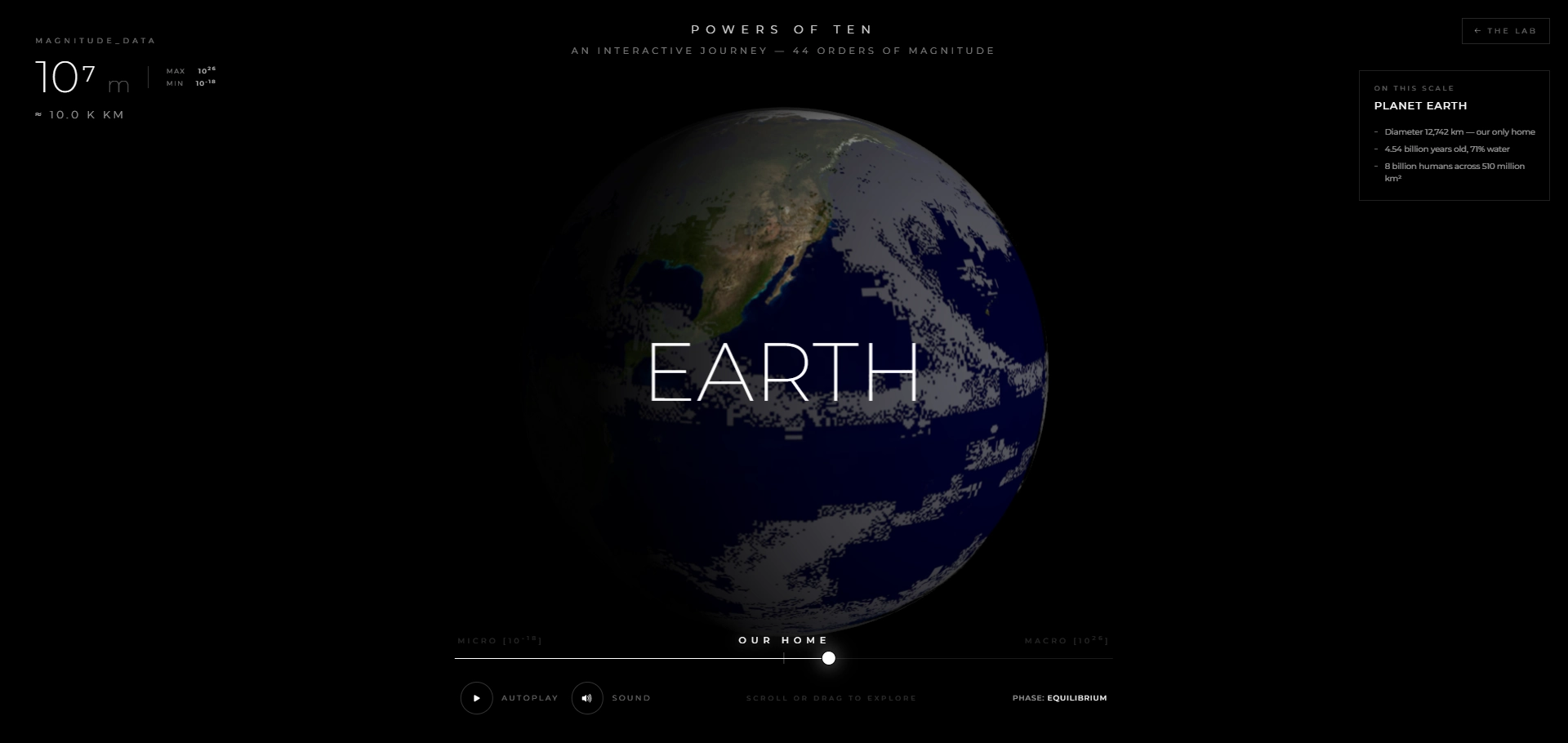
The newest fixture in that wing is an interactive journey across 46 orders of magnitude — from the Higgs Field at 10⁻¹⁸ meters to the Observable Universe at 10²⁸. The 1977 Eames film covered this same territory in nine minutes of linear narration. We rebuilt it as a fully explorable real-time simulation in a browser.
Why the Browser, Why Now
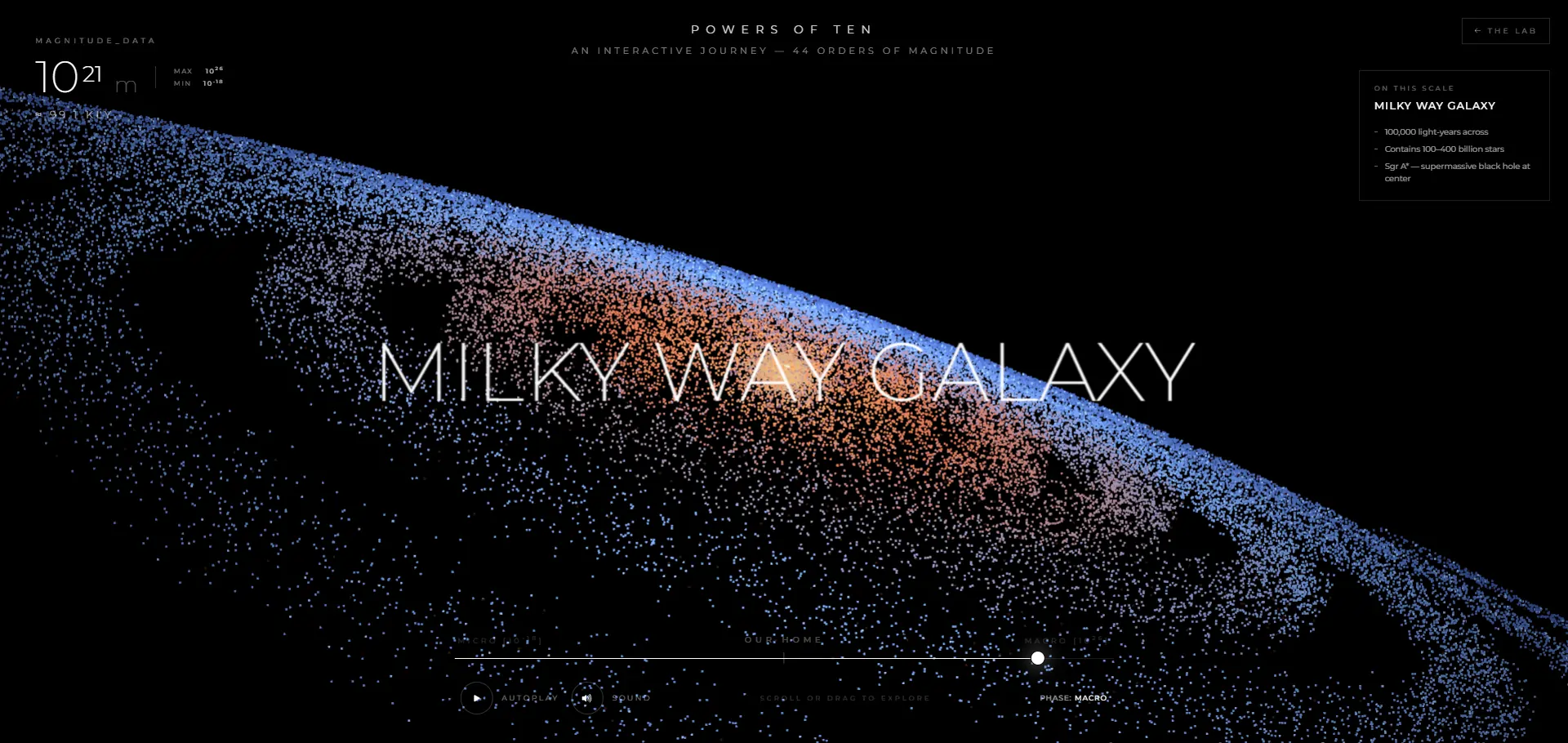
BabylonJS — not Three.js. A deliberate choice. Three.js dominates the conversation around browser 3D, but it optimises for one-off scenes. BabylonJS was architected by a team that ships production rendering pipelines: its DefaultRenderingPipeline for bloom and chromatic aberration, its PointsCloudSystem for 45,000-particle galaxies in a single draw call, Draco-compressed geometry, fresnel-based atmosphere shaders. All of this is designed for real applications, not portfolio demos.
Every decision in the experience assumes a real user on a real device. The iOS device-pixel-ratio is capped at 2x before WebGL initialises. The render loop pauses when the tab is hidden. Audio releases on navigation away. Touch-swipe gestures call preventDefault on non-passive listeners so the page does not fight itself on mobile.
The 45,000-point spiral of the Milky Way — one draw call, barred-spiral geometry with dust-lane coloring.
The Decisions We Refused to Compromise
Every premium experience is a collection of refusals. Four of ours on this project:
1. Linear scale honesty. Earth sits at 56.82% of the slider, not dead-centre. A common UX request would be to compress the micro half so Earth lands at 50% — visually comfortable, intuitively "home." We rejected it outright. The scale is linear by construction. Each pixel on the slider represents exactly equal orders of magnitude. Warping the axis to flatter the user would be a lie we refused to ship.
2. No server-side rendering. The lab page uses Astro's client:only directive. BabylonJS cannot run during static generation — any attempt to SSR the Svelte overlay crashes on window is not defined. We could have engineered around it. Instead we noindex'd the page, skipped SSR, and let the experience run as what it is: a fully client-side simulation. Craft over convention.
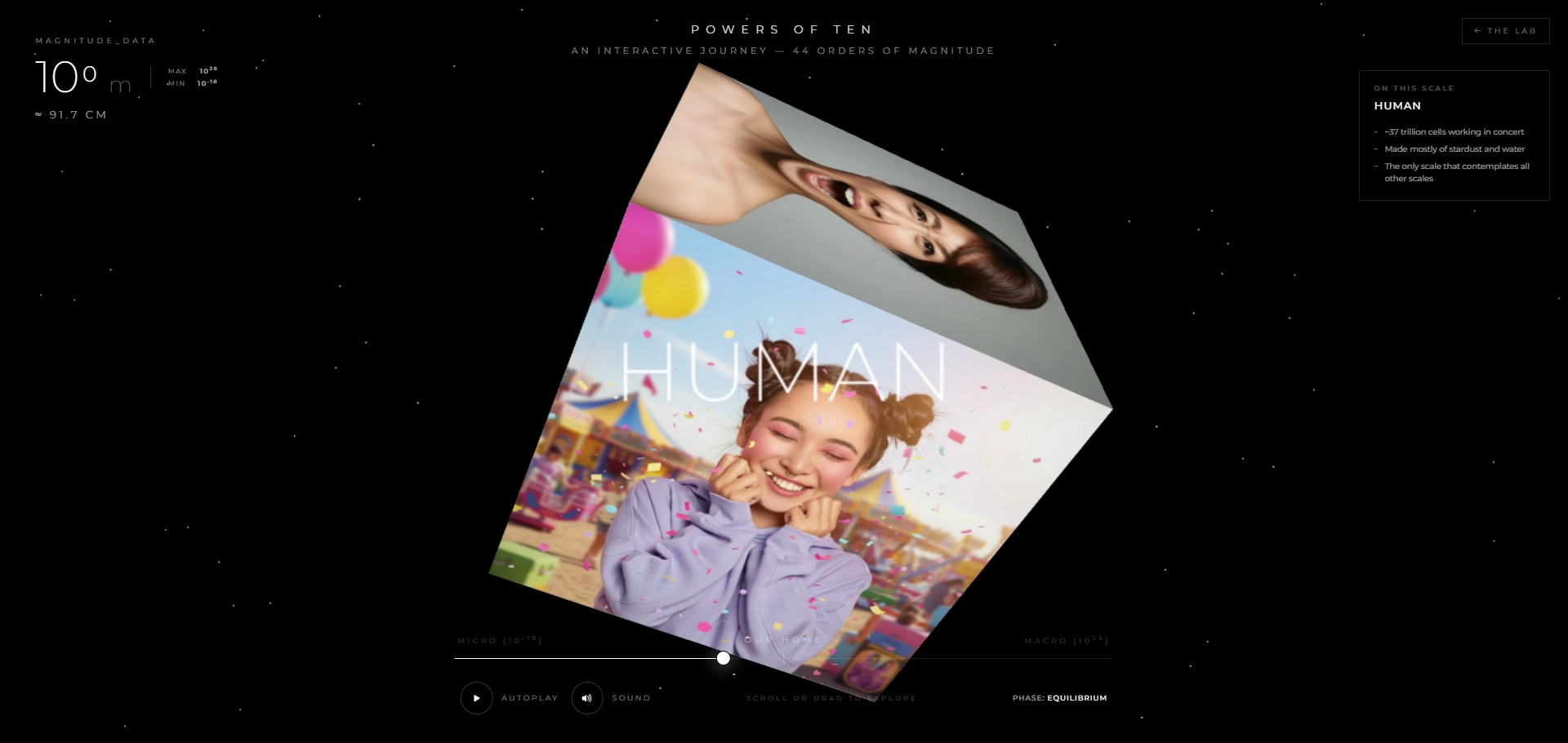
3. A real cube for the human anchor. At 10⁰ meters — the human scale — we needed to represent "us." Procedural primitives got us to a stiff mannequin. Good enough would have been acceptable. We threw it out and built a rotating cube: six faces, six portraits, six emotional facets of the human experience — happy, beauty, elegant, excited, unity, stressed. Each face carries its own lighting-reactive material. Specular highlights sweep across every portrait as the cube turns.
4. A factoid on every anchor. When the user lands within half an order of magnitude of a scale beat, a card fades in: three curated facts about that scale. This turns a visualization into an education. "A bacterium — the simplest living thing. Trillions of them inhabit every human body. Contains DNA, ribosomes, a membrane." We wrote fourteen of these by hand.
"Good enough is a commercial transaction. Absolute is a design philosophy."
The 46-Order Structure
Fourteen scale anchors. Maximum gap between adjacent anchors: six orders of magnitude. The original Eames film had eight scale beats. We added six — filling the void between the Milky Way at 10²¹ and the Solar System at 10¹³ with a "Local Stars" anchor at 10¹⁷, bridging the Atom at 10⁻¹⁰ and the Higgs Field at 10⁻¹⁸ with the Atomic Nucleus at 10⁻¹⁵. No adjacent pair of scales is more than six orders apart. There is never empty travel.
The Human anchor — a rotating cube of six portraits. Lighting reflects across each face during the continuous spin.
What the Lab Page Signals
A prospective client evaluating evaporize is making one decision: do we want the studio that ships what gets signed off, or the studio that ships what they privately believe in?
The Lab Page answers that question before the first meeting. It is why our commercial work commands premium rates. We do not compete with template farms on velocity or price. We compete on the question of what is quietly possible when engineering, motion design, and narrative intent are architected together — by people who have spent the uncommissioned hours on the deepest version of the work.
Powers of Ten, as it lives on our Lab Page, is not a portfolio piece. It is proof of method. A 46-order-of-magnitude simulation that opens with a cinematic drift from the human anchor out to Earth — our home — then hands the user full agency over the camera, the scale, and the narrative speed. It runs in any modern browser. It carries no tracking. Once loaded, it runs entirely on your own device.
If any of this recognises something you want for your own work — a brand website, a commercial experience, an interactive product demonstration that earns the user's attention instead of assuming it — that recognition is the only qualification we ask for.