Powers of Ten
A real-time browser simulation spanning 46 orders of magnitude — from the Higgs Field to the Observable Universe. Fourteen scale anchors. Public proof of our engineering ceiling.
Engineering the Universe, in a Browser
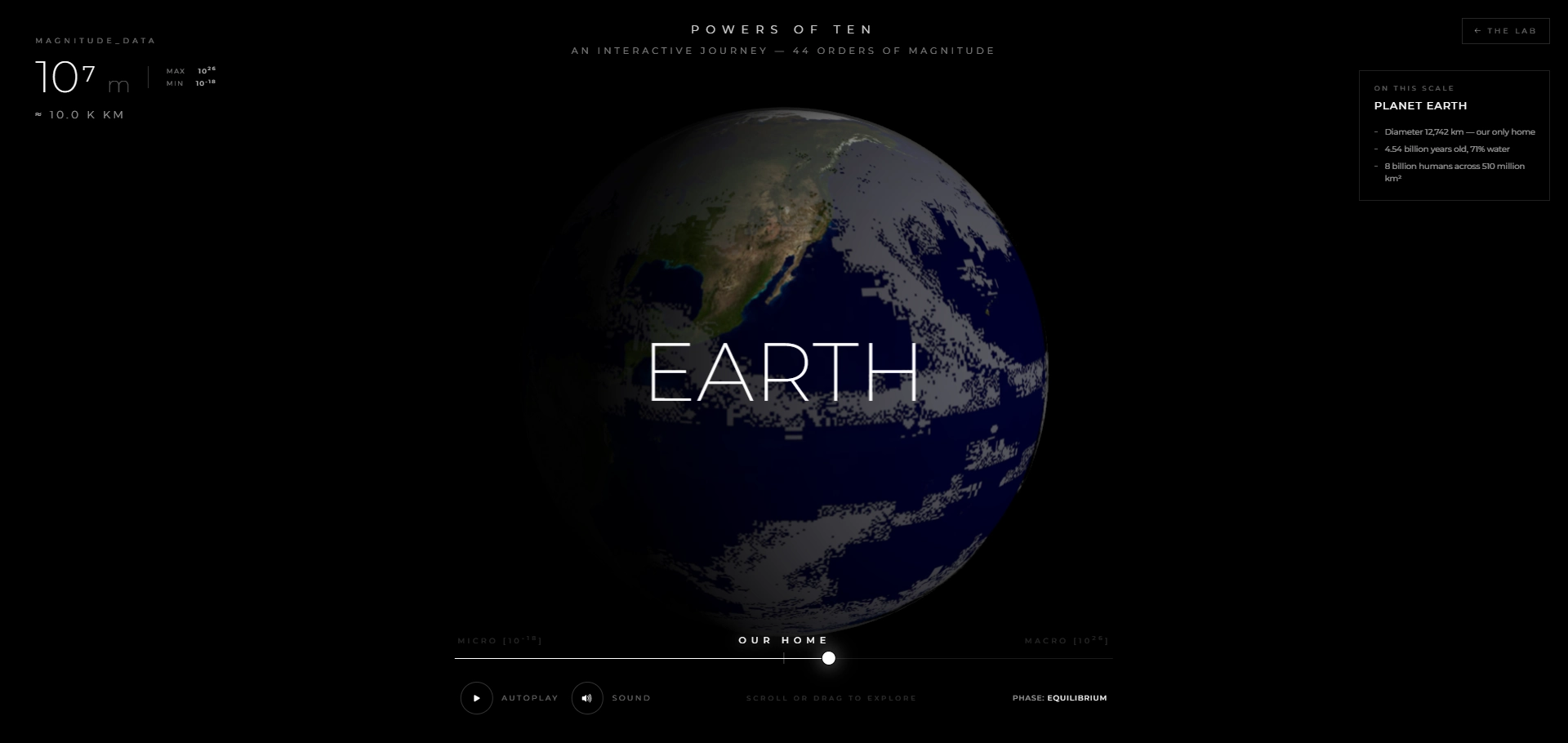
The 1977 Eames film covered this territory in nine minutes of linear narration — a fixed-camera journey from a Chicago picnic out to the edge of the cosmos, then down into the nucleus of a single carbon atom. Fifty years later, the film remains iconic visual education. It is also completely non-interactive. No user agency. No ability to dwell, inspect, or navigate between scales. We rebuilt it from scratch as a real-time, fully-explorable browser simulation. Fourteen curated scale anchors. Forty-four orders of magnitude. Every pixel of slider real estate representing exactly equal orders — no axis warping, no visual flattery, no compromise for user comfort. The user holds the camera. The user holds the pace. The journey from a pharmaceutical pill to the observable edge of spacetime is the same linear scale in both directions.
Engine, Pipeline, Discipline
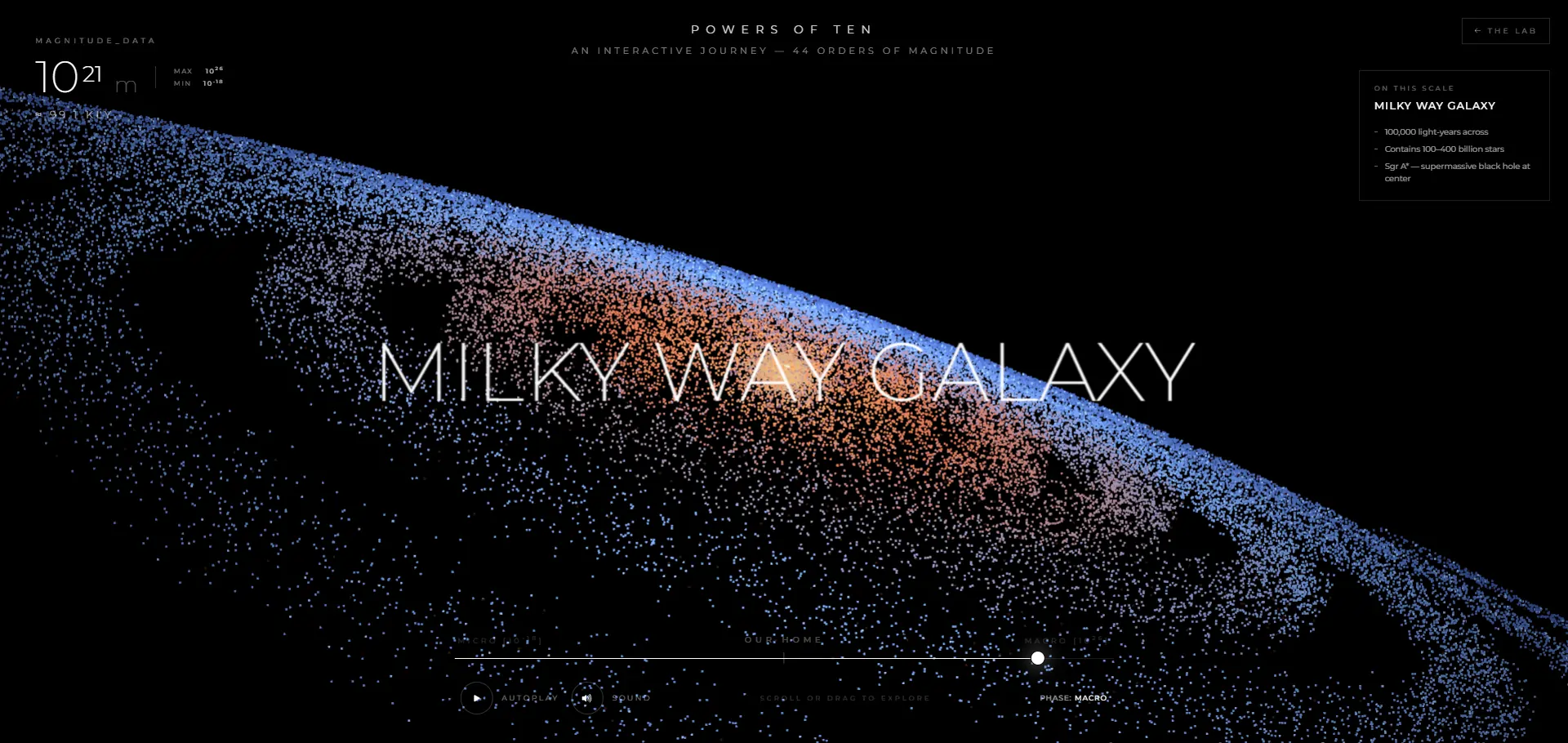
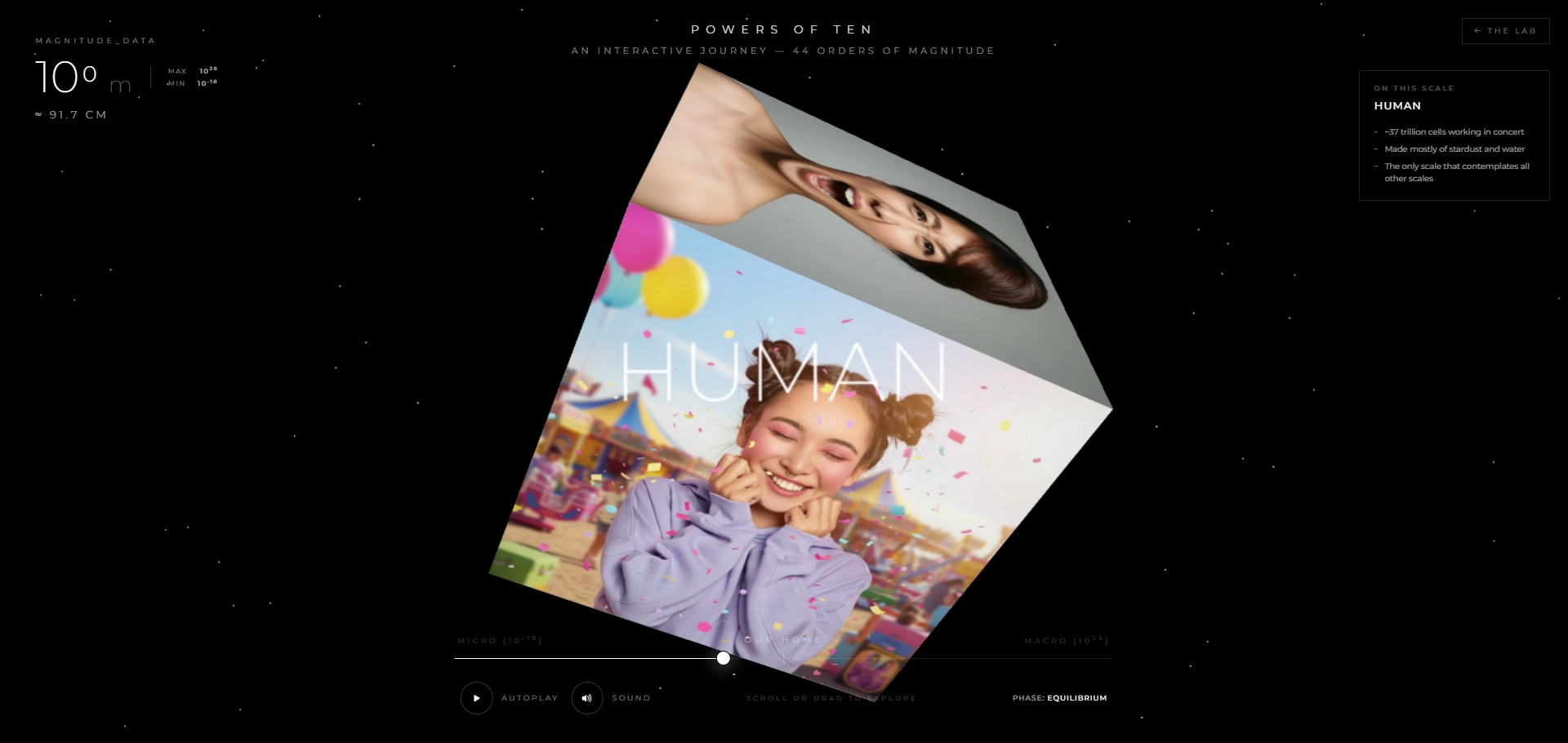
BabylonJS — not Three.js. A deliberate choice. BabylonJS was architected by a team that ships production rendering pipelines: its DefaultRenderingPipeline handles bloom, chromatic aberration, and vignette in a single configuration. Its PointsCloudSystem renders the 45,000-point Milky Way and 55,000-point Observable Universe as single draw calls. Its Draco-compressed geometry keeps the client payload under budget even on mid-range mobile devices. We refused the common UX compromise of putting Earth at 50% of the slider. Earth sits at 56.82% — the mathematically correct position given 25 orders of magnitude below it and 19 above. The axis is linear by construction. Warping it to flatter the user would be a lie we refused to ship. The Human anchor is a rotating cube with six faces — six portraits, six emotional facets of the human experience. Procedural primitives got us to a stiff mannequin. We threw it out. Fourteen factoid cards fade in when the user lands within half an order of any anchor — three curated facts per scale, hand-written. The render loop pauses when the tab is hidden. Audio releases on navigation away. iOS device-pixel-ratio is capped before WebGL initialises. No memory leak. No battery drain. No fight with the browser.
"Shipped April 2026. Lives permanently at /lab/powers-of-10 as public proof of our engineering ceiling. Runs in any modern browser entirely on your own device, carries zero tracking. Accessible via scroll or drag on desktop, touch-swipe on mobile, and full keyboard navigation for power users — arrows between anchors, space to autoplay, M to mute. Not a portfolio piece. A working method made visible."