What a client portal actually has to do
Strip the vendor language away and a law firm portal has four jobs: let a client book time without three rounds of email, let them see where their matter stands without calling, let them pay without friction, and do all of it without leaking privileged information. Everything else is decoration.
That last job is the one that decides the architecture. A retail booking widget can afford a data breach apology. A law firm cannot.
Option one: buy a subscription portal
The fastest route. Legal-tech suites bundle client portals with their practice management, and standalone booking tools can be live in an afternoon.
Where buying wins: speed, and someone else maintains it. If your needs match the template — solo practice, simple consultations, standard payments — a reputable subscription is rational.
Where it quietly fails law firms: the portal is a window into the vendor’s cloud, which means your matter data lives there too (the sovereignty problem we covered in our comparison of practice management architectures). Customisation hits a wall the moment your intake flow doesn’t match the template. And the subscription meter runs forever, per user, whether the portal wins you clients or not.
Option two: build fully custom
The other extreme: commission a portal from scratch, owned outright, shaped exactly to your practice.
Where building wins: total control of the client experience, your brand end to end, no per-user meter, and data wherever you decide it lives.
Where it fails: most firms don’t need a from-scratch build on day one, and paying for one before the practice has proven its digital intake is capital spent on assumptions. Custom software also needs a custodian; a firm with no technical partner ends up with an orphaned codebase.
The hybrid path: front door first, engine when proven
There is a third structure, and it is the one we architect most often: treat the website and the portal as one system, built in phases.
Phase one is the front door: a fast, credible site with booking wired in — not a widget bolted on, but intake designed around how your clients actually arrive. This alone eliminates the email ping-pong that loses impatient clients, and it costs a fraction of a full platform.
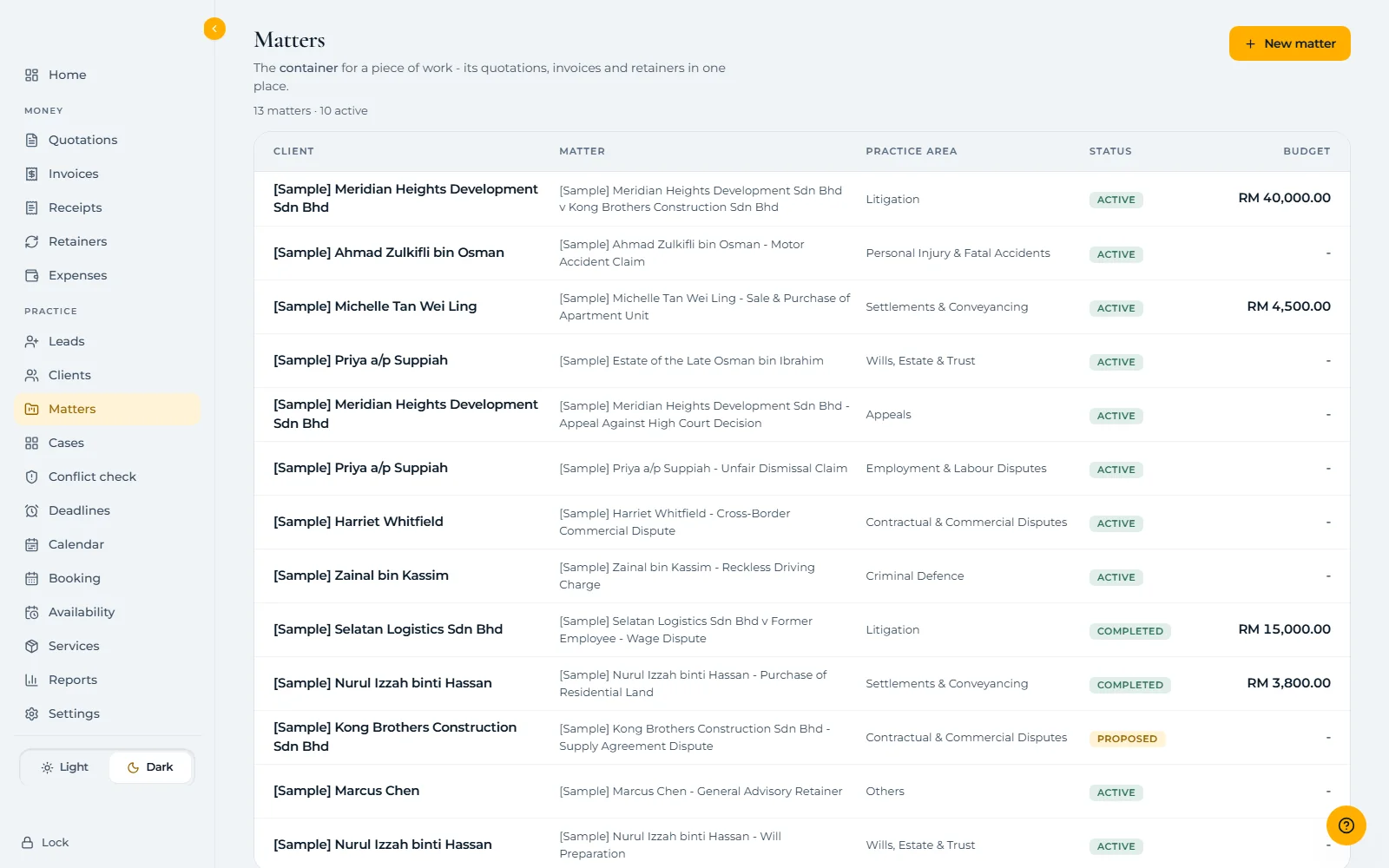
Phase two happens only when phase one proves demand: the operations engine behind the door. Matters, deadlines, conflict checks, invoicing — the machinery your staff touches daily. Because both phases share one architect and one stack, the portal doesn’t need to be “integrated” with your website; they were never separate things.
That sequencing is exactly how our sovereign legal operations console came to exist: the firm’s public architecture came first, the encrypted operations console followed once the practice’s real workflows were understood. Neither phase paid for speculation about the other.
The decision in three questions
- Is your intake volume real yet? If clients aren’t finding you online, a portal polishes an empty funnel. Fix the front door first.
- Does your workflow fit a template? If yes, buy and move on. If your practice spans jurisdictions, currencies, or unusual matter types, templates will fight you monthly.
- Who holds the data? If the honest answer must be “we do”, subscriptions are disqualified before the feature comparison starts.
Firms that answer “real volume, non-template workflow, we hold the data” are hybrid candidates. That conversation starts with the front door, not the full platform — which is also why it doesn’t start with a platform-sized invoice.
If that maps to where your firm stands, scope it through our Project Planner, or write to hello@evaporizestudio.com and describe your intake as it works today.