The question underneath the software question
Law firms do not buy practice management software the way other businesses buy tools. A retailer’s inventory list leaking is a bad week. A law firm’s matter files leaking is a professional catastrophe — privilege, undertakings, and client trust are all on the line. So before comparing features, a firm in Kuala Lumpur or Sydney should ask the architectural question first: where does this software keep my files, and who else can technically read them?
There are three honest answers on the market.
Option one: the cloud suites
The dominant model. Your matters, documents, and billing live on the vendor’s servers, and you access them through a browser from anywhere.
Where cloud genuinely wins: multi-office and remote access with zero setup, automatic updates, integrations with email and accounting platforms, and no server to maintain. For a distributed firm with dedicated IT support, this is a rational choice.
What the brochure does not dwell on: your privileged files sit in someone else’s infrastructure, usually in a jurisdiction you did not choose. Malaysian firms carry obligations under the Personal Data Protection Act; Australian firms under the Privacy Act and its data-breach notification scheme. Both are workable in the cloud, but the compliance analysis becomes your vendor’s architecture plus your obligations — a moving target you re-inherit every time the vendor changes providers, gets acquired, or suffers an incident. Add subscription creep (per-user, per-month, forever) and the exit problem: leaving a cloud suite after five years of accumulated matters is a migration project few firms budget for.
Option two: the legacy on-premise systems
The old Windows practice systems still running in many established firms. The files are local, which quietly solves the sovereignty question — but the software is often decades old, unsupported, tied to one aging PC, and secured by nothing stronger than a Windows login. Local, yes. Protected, rarely. When these systems fail, they fail with the archive.
Option three: the sovereign local-first console
The architecture almost nobody offers, because there is no subscription to sell: a modern practice console that runs on the firm’s own hardware, encrypts everything at rest, and sends nothing anywhere.
Done properly, this means real cryptography, not a login screen. The build we engineered for a cross-border firm works on envelope encryption — the principal’s passphrase derives a key that wraps the data-encryption key, with a printed recovery key as the only other way in. No password reset. No vendor backdoor. Not even the engineers who built it can open the archive. For a profession whose entire value rests on privilege, that is not a feature; it is the correct default.
The honest tradeoffs: the firm owns its own backup discipline, the recovery key must be kept like an office key, and remote multi-office access is not the point of this architecture — it is deliberately an office machine, not a web service. Firms that need ten fee-earners editing the same matter from three cities should look at option one with eyes open. Firms whose real workflow is one or a few principals running their own files will find this model fits the way they already practice.
What a Malaysia-Australia cross-border practice actually needs
Whichever architecture you choose, a firm running matters in both jurisdictions has requirements most generic suites treat as afterthoughts:
- Limitation awareness in both systems of law. A deadline engine that surfaces limitation periods and court dates well ahead of time — and flags hearing clashes — is worth more than any dashboard.
- Dual-currency billing with correct tax treatment. Invoices in MYR and AUD, each with the right tax logic, without manual spreadsheets on the side.
- Conflict checking across every record. Before a new matter opens, the system should sweep clients, opponents, and past matters — not rely on a partner’s memory.
- A calendar that understands the practice, not a bolted-on scheduler: bookings, availability, and matter deadlines in one view.
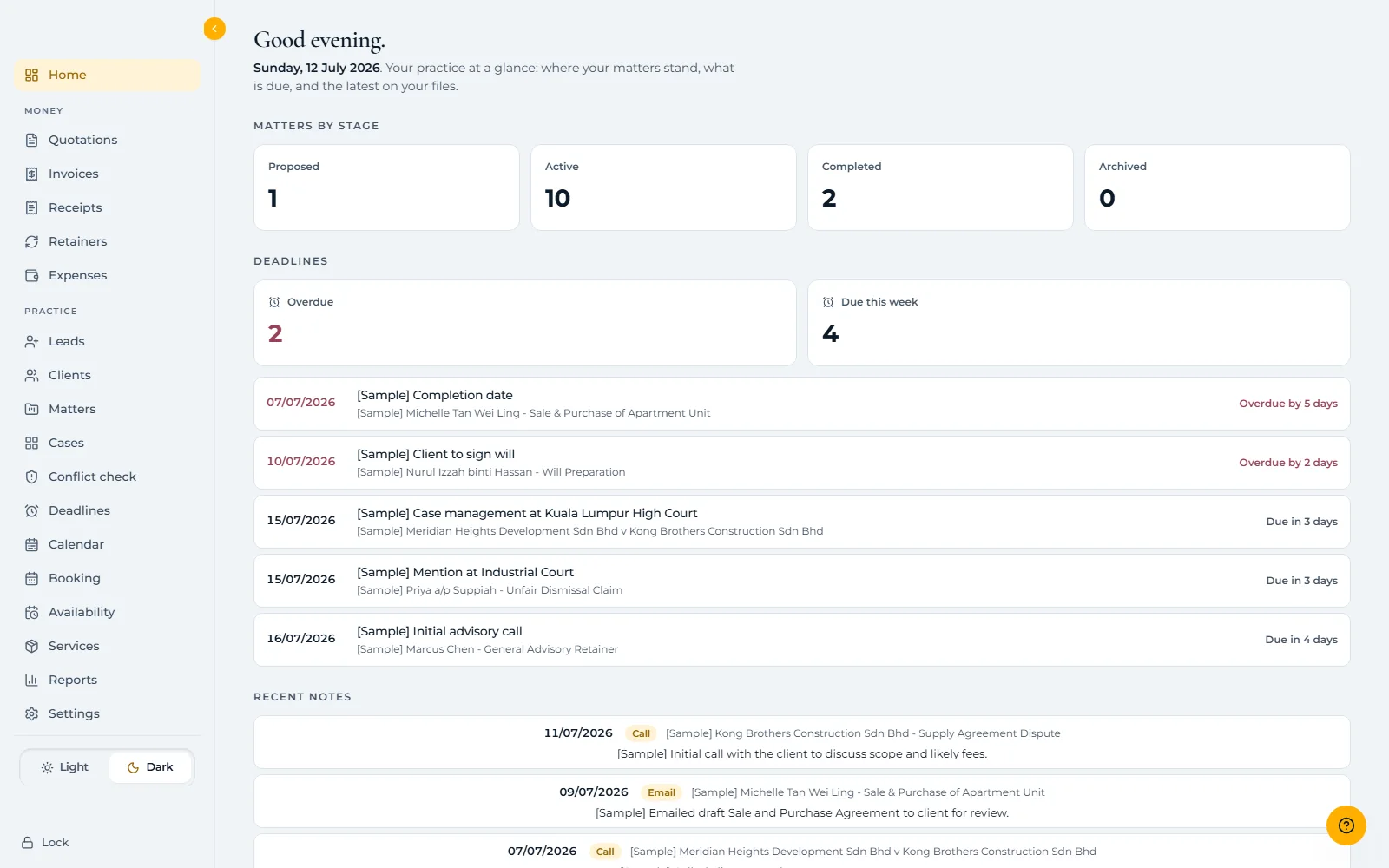
These were the exact requirements behind the sovereign legal operations console we engineered for a boutique firm practicing across Malaysia and Australia — matters, deadlines, conflicts, and dual-jurisdiction billing, encrypted on the firm’s own machine.
How to decide
Ask three questions, in this order:
- Can we accept privileged files living on a vendor’s servers? If no, the cloud suites are out regardless of features.
- Do we have the discipline for our own backups and a recovery key? If no, sovereignty will punish you — choose a reputable cloud suite and do the compliance work.
- Is our practice genuinely multi-office concurrent, or is that a brochure fantasy? Buy for the workflow you have, not the firm you imagine acquiring.
If your answers point toward sovereignty, the build-versus-buy question opens up — and a purpose-built console costs less than most firms assume over a five-year horizon, because there is no per-user subscription bleeding underneath it.
We architect these systems as part of our hybrid practice: the public front door that wins the client, and the operations engine that runs the work behind it. If that is the conversation your firm is ready for, scope it through our Project Planner or write to hello@evaporizestudio.com.